



Written by Amir Nayebdadash Negociador experimentado y altamente calificado
Reviewed by Amir Nayebdadash | Last Updated:
Published:
The Uber Playbook: Profit First, Accountability Later
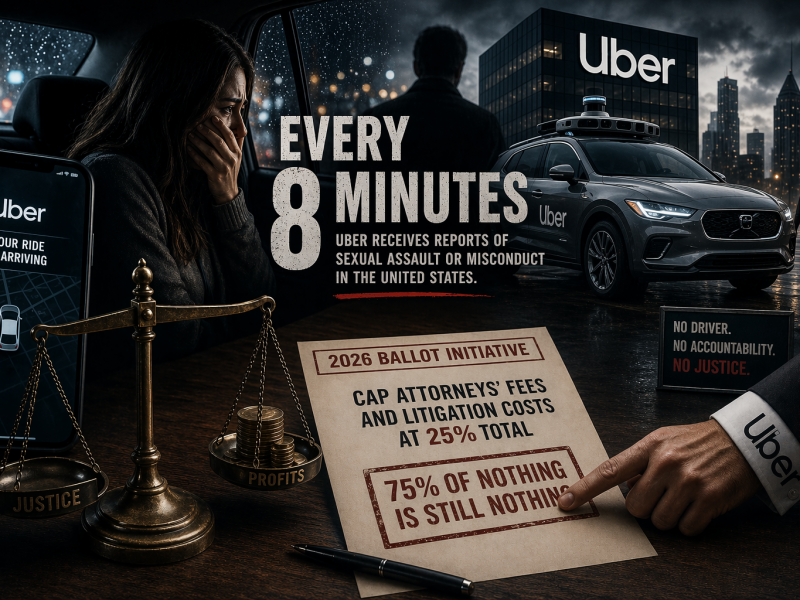
Uber’s playbook is to scale fast, cut costs, limit responsibility, and shift liability, putting profit ahead of safety and accountability. In 2026 it backed a ballot measure to cap attorneys’ fees and litigation costs at 25% total, then dropped that measure in a deal that became SB 623, a law that does not cap attorney fees but limits how much injured people can recover for certain medical costs in ride-hail crash cases.
Every eight minutes. That’s how often Uber receives reports of sexual assault or misconduct in the United States. Every eight minutes is a statistic you have been seeing everywhere, and for good reason. Uber is finally being exposed for their lack of accountability and their lust for greed. Uber is a corporation that has a long history of choosing profit over people, and now, instead of fixing the problem, they are pushing something even more dangerous.
Why Hasn’t Uber Fixed Its Safety Problems?
For years, Uber has faced mounting reports of sexual assault, unsafe drivers, and inadequate screening, and yet, meaningful reform has lagged. Why? Because real safety costs money. More thorough background checks, strict driver vetting, and better monitoring systems all cut into Uber’s profits. So instead of fundamentally improving safety, Uber scaled and accepted the risk.
What Is Uber’s 2026 Ballot Initiative?
Uber’s latest effort is not about improving safety, rather, it’s about controlling what happens after someone gets hurt under their watch. Uber backed a proposed 2026 ballot initiative, marketed under an extremely misleading name: “The Protecting Automobile Accident Victims from Attorney Self-Dealing Act.” At first glance, this seems like a consumer protection measure, and Uber’s pitch is simple, “Victims should keep 75% of their settlement.” Their message is intentional. It’s designed to sound fair, even generous. However, when you read beyond the headline, the reality is very different.
What Would Uber’s Proposal Have Done?
Uber’s proposal would have capped attorneys’ fees and litigation costs at 25% total. Not just fees, but everything required to bring a case: expert witnesses, accident reconstruction, investigators, filing fees, and medical record collection. In real world cases, those costs can reach tens or hundreds of thousands of dollars. Forcing all of it under a single 25% cap would have made many complex injury cases financially impossible to pursue and priced victims out of the legal system.
The pitch that victims would “keep 75%” ignored a basic truth: if attorneys cannot afford to fund a case, there is no settlement, no trial, and no accountability. 75% of nothing is still nothing. In the end, Uber did not win that cap. In 2026, Uber and the Consumer Attorneys of California dropped their competing ballot measures and reached a compromise that the Governor signed as SB 623 on June 25, 2026. SB 623 does not cap attorney fees. It applies only to ride-hail crashes, limits how much injured people can recover for certain medical costs billed by lien-based providers, and requires annual criminal background checks for ride-hail drivers. The fee-cap threat is gone, but SB 623 still narrows what you can recover for medical care after a ride-hail crash, which makes experienced legal help more important, not less.
How the Initiative Would Have Made Injury Cases Harder to Win
The initiative would not have stopped at limiting resources for victims. It also would have made cases harder to win. It would have raised the standard of proof for medical necessity, giving insurers and corporate defendants more room to dispute legitimate injuries. It would also have tied the value of medical care to lower government rates and weakened the system that lets injured people get treatment upfront. Uber’s goal was clear: make it harder to get care, harder to prove injuries, and harder to recover full compensation. Had it passed, fewer cases would have moved forward and fewer people would have been able to hold anyone accountable.
Who Is Liable When a Self-Driving Uber Causes Harm?
While pushing to limit legal accountability, Uber is also investing heavily in a future without drivers. Autonomous vehicles are already here, there is no human behind the wheel, and more importantly, no human to hold responsible. The danger of autonomous vehicles is not hypothetical. During testing in Arizona, one of Uber’s self-driving vehicles struck and killed a pedestrian. What followed was not clarity. When a human driver causes harm, liability is clear, but when it’s software, sensors, and algorithms, liability becomes fragmented. This fragmentation benefits Uber, because the harder it is to assign fault, the easier it is to avoid it, and now, thousands of drivers will be out of a job. Not because they are unnecessary, but because removing them removes risk. Replacing drivers with machines results in lower costs and lower accountability.
Has Uber’s Playbook Changed?
Uber’s playbook has not changed. Scale fast, cut costs, limit responsibility and shift liability. What they claim to be progress is distance. Distance between the company and the harm, distance between victims and justice, and the greater that distance becomes, the easier it is for accountability to disappear entirely.
Negociador experimentado y altamente calificado
Lawyer Amir Nayebdadash is a founding partner of Protection Law Group. A knowledgeable Employment Attorney, Mr. Nayebdadash is a seasoned negotiator and highly skilled trial lawyer who has obtained numerous multi-million dollar settlements and verdicts on behalf of his clients. When not vigorously fighting to protect the rights of Plaintiff Employees, Amir spends time with his family and friends, travels, plays chess, follows international football, and enjoys craft beers and patronizing eclectic restaurants.
 Español de México
 English