


Ariana Dowlatshahi | Protection Law Group
The Uber Playbook: Profit First, Accountability Later
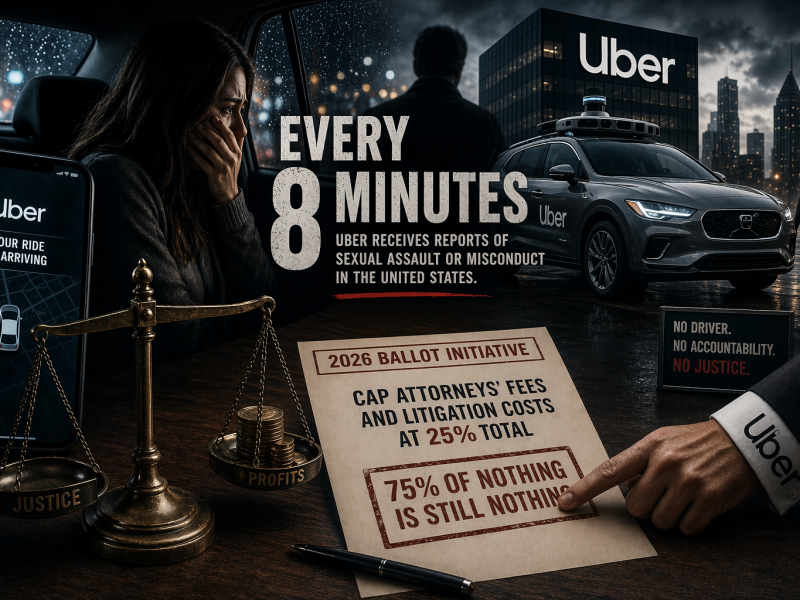
Every eight minutes. That’s how often Uber receives reports of sexual assault or misconduct in the United States. Every eight minutes is a statistic you have been seeing everywhere, and for good reason. Uber is finally being exposed for their lack of accountability and their lust for greed. Uber is a corporation that has a long history of choosing profit over people, and now, instead of fixing the problem, they are pushing something even more dangerous.
For years, Uber has faced mounting reports of sexual assault, unsafe drivers, and inadequate screening, and yet, meaningful reform has lagged. Why? Because real safety costs money. More thorough background checks, strict driver vetting, and better monitoring systems all cuts into Ubers profits. So instead of fundamentally improving safety, Uber scaled and accepted the risk.
Uber’s latest effort is not about improving safety, rather, it’s about controlling what happens after someone gets hurt under their watch. Uber is backing a proposed 2026 ballot initiative, marketed under an extremely misleading name: “The Protecting Automobile Accident Victims from Attorney Self-Dealing Act.” At first glance, this seems like a consumer protection measure, and Uber’s pitch is simple, “Victims should keep 75% of their settlement.” Their message is intentional. It’s designed to sound fair, even generous. However, when you read beyond the headline, the reality is very different.
This proposal would cap attorneys’ fees and litigation costs at 25% total. Not just fees, but everything required to bring a case. This includes expert witnesses, accident reconstruction, investigators, filing fees, and medical record collection. In real world cases, those costs can easily reach tens or hundreds of thousands of dollars. By forcing all those expenses into a 25% cap, Uber is effectively making complex injury cases financially impossible to pursue. This will price victims out of the legal system entirely.
The idea that victims will “keep 75%” sounds appealing. However, it ignores critical reality and logic. If attorneys cannot afford to take the case, there is no recovery at all. There is no settlement, no trial, no accountability. Without the ability to fund experts, build evidence, and fight large insurance companies, the case simply does not move forward. Which leads to the most important truth behind Uber’s marketing, 75% of nothing is still nothing.
This initiative doesn’t stop at limiting resources for victims. It also makes cases harder to win. It would raise the standard of proof for medical necessity, giving insurers and corporate defendants more room to dispute legitimate injuries. It also ties the value of medical care to lower government rates and weakens the system that allows injured people to get treatment upfront. What Uber wants to accomplish is clear, make it harder to get care, harder to prove your injuries, and harder to recover full compensation. When all of that happens at once, fewer cases move forward and fewer people are able to hold anyone accountable.
While pushing to limit legal accountability, Uber is also investing heavily in a future without drivers. Autonomous vehicles are already here, there is no human behind the wheel, and more importantly, no human to hold responsible. The danger of autonomous vehicles is not hypothetical. During testing in Arizona, one of Uber’s self-driving vehicles struck and killed a pedestrian. What followed was not clarity. When a human driver causes harm, liability is clear, but when it’s software, sensors, and algorithms, liability becomes fragmented. This fragmentation benefits Uber, because the harder it is to assign fault, the easier it is to avoid it, and now, thousands of drivers will be out of a job. Not because they are unnecessary, but because removing them removes risk. Replacing drivers with machines results in lower costs and lower accountability.
Uber’s playbook has not changed. Scale fast, cut costs, limit responsibility and shift liability. What they claim to be progress is distance. Distance between the company and the harm, distance between victims and justice, and the greater that distance becomes, the easier it is for accountability to disappear entirely.
 English
  Español de México